"They are all correct."
"How could they ALL be correct? They contradict each-other. You can't have Heaven and Valhalla be the afterlife. If Heaven exists then that means that Valhalla doesn't. And vice-versa."
"Think of it as parallel universes."
"But doesn't the idea of a God transcend multiple universes? Isn't God the god of all universes?"
"Yes."
"And so is Zeus?"
"Yes. Infinite, parallel parallel universes."
"Which universe is Earth in?"
"Earth is Earth. The afterlife is different. It is when you change over."
"So if I'm from Earth, which one do I go to?"
"It depends on what you believe. You determine where you go, when you cross over."
"So if I believe in Judeo-Christian Heaven?"
"Then you go there."
"But what if I believe in that, but don't think I lived well enough?"
"Then you go to Hell."
"Does that mean there isn't a God?"
"All of the gods are. You go to the one you believe in."
"What if I believe in reincarnation?"
"Then you will be reincarnated."
"On Earth?"
"On an Earth, yes."
"What about the atheists?"
"They cease to be."
"That doesn't seem fair. They die?"
"It is what they believe happens. It is what they cause to happen."
"So if you don't have faith in something, you die?"
"Faith is not a belief in what might happen. It is what happens. It causes it to happen. If you believe death is the end of your existence, then it is so."
"So where would I go?"
"What do you believe?"
"I don't know, really. I believe... or maybe I hope something happens. I always had a hard time believing one church was right and that the others were wrong. Or that any of them were right. I guess I figured I would find out when it happened. I hope I will have a chance to figure it all out afterward."
"That is how you ended up here."
Friday, March 19, 2010


Monday, May 11, 2009
Concept Art
Some concept art for a project I'm working on with my oldest son. He's the artist, not I.


Tuesday, March 27, 2007
I'm glad you got your kid back
Erik takes his kids to Disneyland, but manages to lose the 3-year-old. But that's OK, he had hung a USB flash drive around the kid's neck, and had him back within 13 minutes.
Anyway, I actually am glad he got his kid back so quickly. Nothing is worse than having your young child go missing. But...
So the father planned ahead, that's good. If you'd like to do the same yourself, I see that SurplusComputers has a 2-pack of similar-sounding drives for about $8.
But I can't say I recommend you do that. Instead, I recommend that you plant the equivalent of a dog tag on your kid. It's no worse than the USB version, and you're much more likely to get someone with a cell phone and no computer handy to just read the tag and call you.
Heck, if you know you're probably going to lose your kid at Disneyland, I bet you could get them back in just 5 minutes with the dog tag.
Oh, and I see the lost USB drive thing just relies on Autorun to pop up the message. Disneyland Security, you just got pwned by a 3-year-old. Pentesters, are you paying attention?
Found via The Disney Blog.
Our three year old did just what we thought he would do - Disappeared. Within 13 minutes of being ‘lost’ though, my cellphone rang.The little scamp.
Anyway, I actually am glad he got his kid back so quickly. Nothing is worse than having your young child go missing. But...
So the father planned ahead, that's good. If you'd like to do the same yourself, I see that SurplusComputers has a 2-pack of similar-sounding drives for about $8.
But I can't say I recommend you do that. Instead, I recommend that you plant the equivalent of a dog tag on your kid. It's no worse than the USB version, and you're much more likely to get someone with a cell phone and no computer handy to just read the tag and call you.
Heck, if you know you're probably going to lose your kid at Disneyland, I bet you could get them back in just 5 minutes with the dog tag.
Oh, and I see the lost USB drive thing just relies on Autorun to pop up the message. Disneyland Security, you just got pwned by a 3-year-old. Pentesters, are you paying attention?
Found via The Disney Blog.
Saturday, February 10, 2007
I'm in ur package, playing with ur puzzlez
So one of the developers I work with, Dave, is quite the twisty-puzzle fanatic. Take a look at some of his photos on flickr, and you'll see what I mean. Here's something like 1/3 to 1/2 of what he has in his office at work:


As you might imagine, Dave is also on all the various puzzle sites, and knows which puzzles are rare, which are worth the most, and which ones he doesn't have. Recently, he worked out a trade with some other puzzle collector in another country. He shipped a Square-1 in exchange for a few other puzzles. This is what arrived in the mail:
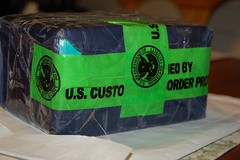
Yes, go ahead and look at the larger version of that pic. That's the Department of Homeland Security logo. So what was inside that caused such alarm that they had to open his package in transit to inspect it?
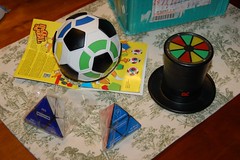
We suspect it was the rare and unusual Rubik's Hat that caught their attention. Had it been your run-of-the-mill 3x3, I doubt they would have felt it necessary to play with it. or maybe they saw The Da Vinci Code recently, and it looked like a cryptex on the x-ray?
Rubik-sniffing dogs?
Dave did note that whoever was fondling his hat didn't seem to have any luck solving it. Good thing he didn't trade for something with batteries and wires.
Update: As if to further prove his cube-geekiness (did I mention that he placed fairly well at the recent cube-solving time trials?) Dave writes:
As you might imagine, Dave is also on all the various puzzle sites, and knows which puzzles are rare, which are worth the most, and which ones he doesn't have. Recently, he worked out a trade with some other puzzle collector in another country. He shipped a Square-1 in exchange for a few other puzzles. This is what arrived in the mail:
Yes, go ahead and look at the larger version of that pic. That's the Department of Homeland Security logo. So what was inside that caused such alarm that they had to open his package in transit to inspect it?
We suspect it was the rare and unusual Rubik's Hat that caught their attention. Had it been your run-of-the-mill 3x3, I doubt they would have felt it necessary to play with it. or maybe they saw The Da Vinci Code recently, and it looked like a cryptex on the x-ray?
Rubik-sniffing dogs?
Dave did note that whoever was fondling his hat didn't seem to have any luck solving it. Good thing he didn't trade for something with batteries and wires.
Update: As if to further prove his cube-geekiness (did I mention that he placed fairly well at the recent cube-solving time trials?) Dave writes:
Nice, although technically it was my custom modified Square-1 that I traded, as a vanilla Square-1 is only worth $20-$30. I hear that the maker may even be doing another round of production, in which case the price might go back down to $9.99 or so. Here's a flickr picture of my custom modification:
http://farm1.static.flickr.com/135/362992417_66e4734f8a.jpg
I stand corrected.
Saturday, February 03, 2007
Amazon Links
I'm trying to see what Amazon links look like now. I've had an Amazon affiliate account for years, but I have barely ever used it. I used to just throw my associate ID ("thievco") onto links, but it looks like that changed probably around 2004. Amazon sent me a quarterly report email the other day, so I thought I would look into it. I plan to mention books frequently, and I'm not at all above throwing on my associate ID. But I wanted to see how it was going to look.
Here's one for my latest book, which is now in print and in stock:
Let's see how that looks. I may twiddle this post, apologies if it shows up in a feed multiple times. Of course, this is all javascripty, so if you're reading this in an RSS reader, you probably don't see it at all. Don't worry, I'll do a proper post in the near future where I shill my latest book the right way.
Update: Whoops! I was wrong. I found the right report, and I did get some hits from the old-style affiliate links. I put a link somewhere, and two people bought a book based on that. I have earned 83 cents this year so far. Thank you for the support. ;)
Tuesday, January 09, 2007
Voicemail from bureau of prisons
I walked into the office this morning, and glanced at my phone. It said I had 7 new callers since I left yesterday. Now, I'm not much of a phone person. I hate them. I think that comes from a brief stint I did on the help desk phones at Bechtel.
So, most people know not to call me. I scrolled through the caller-ID list, and there were 6 calls from the same number within about a hour. The number didn't look familiar. Curious, I checked my voicemail, which is something else I rarely do. A man identified himself as being from the IT department of the bureau of prisons, said he had a question for me about a request from an inmate for a book that I wrote the foreword for, and would I please call him.
Uh, sure.
Turns out that someone had put in a request for How to Own a Continent. His opening question was "This isn't fiction, is it?". I explained that it IS fiction, in that none of the events happened, but that we try to keep the technical details real. So yes, it's half fiction, and half technical book. By the time I had called him, he had already taken note of the price and where it is supposed to be shelved, and decided on his own that it didn't qualify as a novel. He made it sound like he had a copy in front of him, which I guess he wasn't planning to forward to the inmate.
I feel a little bad for the inmate who probably won't get to see it now, but I wasn't going to lie about it. I didn't try to grill the prison IT guy, or argue with him about his policies. I figure that was probably pretty futile. Maybe I'll call him back at some point and see if there's anything he is allowed to tell me about which prison this is or the name of the inmate. I assume he can't, but you never know.
If the inmate in question ever sees this: When you get out, or if you transfer somewhere where they are a little more lenient about your reading material, I'll get you a copy.
Monday, November 06, 2006
Shut down the Internet
A Sybase story this time. I was a network & security guy at Sybase for just under 5 years, between 1995 and 2000.
Speaking of 2000, I was at Sybase for the Y2K rollover. Like most IT shops, we had spent a couple of years planning for Y2K, and as it got closer, we got busier. Then I get a visit from the director of telecom. He tells me that for the rollover weekend, we will be shutting down all Internet, dialup and ISDN links.
What?!?
Yes, his boss, one of the co-CIOs we had at the time, told him to cut off all outside communications because of hackers. The request got dropped in my lap, because I was in charge of all the Internet links, firewalls, and dialup lines.
What?!?
It was explained to me that our CEO, John Chen, had been golfing with one of his buddies from HP, and he had heard through the grapevine that the hackers were going to be out in force on the Y2K weekend, and were saving their attacks for when companies were at their most vulnerable. Therefore, we were going to preemptively take down our communications links, just like HP!
(Remember the scandal about HP taking themselves off the net over the Y2K weekend, screwing their customers? No, you don't. It didn't happen.)
I tried, briefly, to deal with my upstream management on the issue. Nope, I was told it was a done deal. This was several days before the rollover.
I didn't wait long to go over everyone's heads and email the CEO explaining why he was making a mistake. Reasons included things like "You're going to make SURE you have a major outage on the chance that you MIGHT have an attacker-driven outage." "I know a lot of these 'hackers' they will either being working on Y2K at the day job, or drunk for New Years." "What about all of our customers who need last-minute Y2K patches? What about all of our OWN people who need the same from other vendors?" "Do you have any idea what level of attack we already get and live through every day? We get over a million failed connection attempts every day. Literally!".
And he started to relent. I had a reasonable explanation for each of his concerns.
The "deal" was that I would build a monitoring team, so that we had 24-hour around-the-clock coverage of the firewalls and other logs, looking for anything suspicious. I had to report in every so often. Anything really bad, and we would have to pull the plug.
Of course, nothing happened. After about 12 hours, the CEO got really, really bored looking at attack reports. Oh look, a port scan. Oooh... a distributed port scan! Hey, 100,000 attempts to connect to a telnet port that isn't listening.
But I had had to make 8 network & security people work the entire Y2K weekend, 8 hours on, 8 hours off, to be allowed to keep the links up. These were 8 people who had done their jobs ahead of time, like they should have, and by all rights should have had a nice relaxing New Years Eve for the big millenium switch.
And Sybase was just going to screw their customers. Not to mention making us as a company look like idiots.
So, I got my way, forced Sybase to do the right thing, and had to suffer for it. And naturally, I got the warning email after about "going through channels" (which would have got me exactly nowhere. I had had about 2 days.)
I left Sybase on January 31st to go work for SecurityFocus. Sybase had made a corporate decision to essentially spam people, also over my objections. (Did I mention that I was abuse@sybase.com?) Plus, I was starting to get the kind of treatment that made it clear I was being punished for going over people's heads. This just after I had tracked down a rogue sysadmin who was embezzling (a story for another time.)
Since then, I've taken jobs with people and companies that actually care about security.
(No, don't lecture me about what year the millenium rolled over. I have my own ideas about that.)
Saturday, November 04, 2006
Crashing MailWorks
Another Bechtel story.
Bechtel had standardized on DEC MailWorks for their corporate email standard. Previous standard was PROFS on the mainframe. We had enough MailWorks users going that we needed a VMS cluster to deal with the volume, and have some redundancy in case of an outage, maintenance, etc... all the stuff you want a cluster for. I'm actually DEC certified on some of this stuff. I get lots of use out of that now, let me tell you.
One day, mail goes down. The senior VMS admins determine that the MailWorks server process had gone down. On all the machines in the cluster. At the same time.
OK. So they try to run it again, and it comes up. As they are trying to bring it up on another machine in the cluster, they both go down again. It had only been up for a few minutes. So they try one machine by itself. It runs for a minute or two, and goes down again.
They do some dump analysis, and can see that the process is crashing. Not that this helps with how to fix it. After a bit of in-house fiddling, DEC is called. Some phone support doesn't help, must be a hardware problem somewhere. On every box in the cluster? OK, a hardware problem in the cluster interconnect (CI), then. Waste time, cannibalize hardware, break cluster, determine that problem happens on one server, no cluster, and machine works fine for all other software. Dispatch DEC technician to site.
Reload OS, MailWorks software, runs clean. Problem solved? No, when you give it the mail spool, it crashes again. And yes, we DO need our old mail, thanks anyway.
But now we know it's something in our mail files that is causing it. Maybe we can figure that out and surgically remove it? OK, so they binary split the files, and determine that a single email is causing the problem.
This is several days into an outage, mind you.
Email is examined, and it turns out to have a really long subject line, like thousands of characters, almost all spaces. Some experimentation shows that once you hit a subject line of 1K or so in length, MailWorks takes a dive. (Ah yes, I saw that light bulb go off over your head.) And if you have a cluster, when one server crashes, the next one dutifully takes over mail processing, until it hits that same message.
Message is purged, and people can actually get back to work.
They track down the user who sent the killer email, to find out what the heck she was thinking. Turns out she was eating breakfast, and reading her email. A piece of Grape Nuts cereal lodged in her keyboard, and managed to hold the spacebar down. She still sent the email after that, but remembered having to dislodge the offending Grape Nut.
So an entire VMS MailWorks cluster got taken out for days by a piece of Grape Nuts. But that's not the punchline.
After DEC support had been largely useless for days and our guys had to more or less had fix it themselves, we submitted a fix request. We didn't want this happening again. We were able to send a specific problem description, number of characters, sample email, the whole bit.
DEC's response was: Oh yeah, we know about that! Here, we've had a patch available for a while. Why weren't we (one of the largest MailWorks installations in the world) told about that? Oh, uh... you have to call with a problem description that indicates that patch is needed. OK, and when we DID call with a problem like that? And you sent out a technician, why didn't he know? Why don't you publish the patch list? Uh.. well...
And I believe that was my first practical introduction to buffer overflows and vendor patching.
Saturday, September 09, 2006
Why can't I print this email?
Why can't I print this email?
Many years ago (about 1990-1995) I worked at Bechtel in San Francisco. It was the kind of place that made you wonder if Dilbert creator Scott Adams worked there. So I will likely have a number of stories that are set there, if i can remember them.
Bechtel was a long-time DEC VAX shop, so we ended up using a lot of strange DEC products, probably long after we should have been. For example, DEC PathWorks, which was DEC's weird LANMAN-based NETBIOS over DECNet (Phase IV). We were also using the DEC email product, I want to say it was called "MailWorks", but I can't actually remember. A lot of their stuff had "works" in the name, I think they were trying to convince themselves. And this is back in the day when Windows wasn't a given, and we're talking Windows 3.1x.
So one of the executives calls the helpdesk, and wants to know why he can't print his email. We thought that was a little strange, since the printing generally worked well. We troubleshot the usual queue problems and such, and then sent someone up to see him. OK, so the problem turned out to be that the print function just wasn't there in the program mode he was in, which was the compose mode. In other words, he wanted to print the note while he was still typing it up.
OK, so why did he want to do that, we asked him. He said he couldn't send it unless he printed it out. Huh? Of course he could, just press the "send" button. And you can even print it out from your "sent" items, if you want. No, he doesn't want to send it that way, and he needs to print it!
After backing up several steps, the person finally gets the full story out of him. What he wanted to was type it in the compose window, print it out, and the FAX it to the person it was addressed to. That's right, he just wanted to use the email program as a word processor.
When questioned as to why he didn't just send it via email, he said that he couldn't be sure it got there that way. OK, so why is FAX any better? You can't tell that it got sent for sure that way either.
Yes you can, he replied. You can see the paper going into the machine, so you know it got sent.
Tap Whistle
Tap Whistle
(Orginally from a writing exercise I did in my Slashdot Journal. There's a writer there by the name of SolemnDragon, and she occasionally gives out said exercises. This "universe" is one I've had in mind for a while. I haven't been satisfied with the level of tech detail in other steampunk stuff I've read. I may do more in this vein, we'll see.)
Tap Whistle hated to work in the rain. It loosened the black from the streets and buildings, and made the manhole diving unbearable. You didn't want to get caught by the Plumbers when it was raining. If you tried to run, you'd just end up slipping in the black runoff. After a couple of hours of rain like today, the sewers would be full up to your knees.
It also seeped into the battery jars, and the top layer of grease would short out the 'nodes, leaving you no voltage. Anyway, you didn't want to get caught with a jar if you could help it, or else you would be charged under the Tesla ban.
The rain made it too noisy to scope the street for audio, too. Not that sound would do him any good at the machine point he planned to monitor today, not from the topside.
Whistle wouldn't even bother on a day like today, except that he had a rare motivation, a paying customer. It seems that several of the local "plumbers apprentices" had named him as the best when the norm had come around looking to hire a hole diver. He was even more nervous than Whistle, and it made him laugh inside to think how paranoid the norm was about getting caught. Whistle wasn't worried, why not get paid for some of his fun? He suspected he wouldn't be able to get the message anyway.
Whistle didn't actually have to pop any holes today, so he had left the crowbar at home. This junction point was big enough that it had its own housefront. Most of the major machine points had a little house-like building on top of them. The house part was little more than a single-story box with a front door. Inside was just some storage, a wall of valves that ran below, and the circular metal starcase that led down to the workroom. Whistle had a key that he had traded for, that would open the front door. It was a simple warded key, not one of the newer pin tumblers. Those were not thought to be reliable enough, though the lockers considered them more secure. That was about the extent of Whistle's lock knowledge, which he had mostly picked up from trade pamphlets and a couple informal demos from the lockers at the meetings.
Whistle checked for any of the copper-clad Plumbers carriages on the street before letting himself in the door. Once inside with the door closed behind him, he headed straight downstairs.
At the bottom of the stairs, he stepped right into the water, feeling the cold grip on his calves, dragging at his pant legs. The rain was seeping from the walls, and dripping from the curved ceiling, between the bricks. Parts of the sewers under the city went back to Roman times, though not under a machine point. In a machine point like this, they had typically been dug down two stories worth, and rebuilt, like a mini Underground station in the dark. They didn't carry any trains though, just pipes and conduit.
Whistle's target today was Lloyd's. They were an old user, so they still mostly used the pneumatics. Usually, only the newer users used rods, because they didn't have as many feeds to convert. There were a couple of exotic hydrolics in town, used in local building carrys, but that was only the standard in America. You wouldn't find a hydrolic in an official machine point. Whistle had a few catalogs from Edison's Hydrologic Manufacturing Company, describing what they had over there.
He lit the gaslight, and pulled a couple of books from his pack. One was the city feed directory, which would give him the numbers he needed to check for. Customers would use these to look up the endpoint and route. The other was a stolen PCL manual, which would give him the stamped numbers he would need to read off the pipe he wanted. He looked up the machine station he was in, and found the list of Lloyd's serials. Lloyd's had mostly low numbers, they had been around longer.
One challenge was that, through this particular station, Lloyd's had no less than 21 tubes, too many to monitor at once. Whistle knew to check which switch they went to, though. And only one switch down here lead to the destination he was supposed to watch for.
He found that only four of the tubes went through that switch, so that was the set he would have to watch. From his bag he pulled a set of loadstones and reed flags.
Carefully, he found the places in the middle of the tubes where the plungers would have to cross. The places where, when the plunger went back and forth, it would flip the flag one way and then the other, giving him a visual means of watching the bits. Down here, you could use a horn to listen to one pipe, if you only had one to watch. Well, maybe two. He had heard of one blind kid that could do two at once.
For a lot of beginners, tapping by ear was easier. Especially if you were used to decoding by ear at a legitimate endpoint anyway.
But that didn't help if you needed to watch four. Whistle set up the reeds so that the reflective sides were to the right, where the gaslight was. Once the plunger started going, the flashes would let him read the message right off the pipe.
 Full RSS Feed